
Vaccines of the past required new designs and protocols for each pathogen, making the process expensive and time consuming. A new modular vaccine platform might provide a better approach to designing vaccines, turning what once was an artisanal process into a “plug and play” assembly line.

From https://schaeffer.usc.edu/research/covid-vaccine-lives-saved-study/ licensed under Creative Commons Attribution 4.0 International License
The recent April 2026 outbreak of hantavirus on cruise ships gained global attention due to the sudden emergence of the virus and the potential concern for human to human transmission. Like other understudied viruses, there is no vaccine or treatment for hantavirus. This leaves the global population at risk for infection and could allow for the spread of the virus. Like hantavirus, there are still many emerging and re-emerging pathogens that have the potential to cause deadly epidemics if new vaccines can not be produced when needed. If a vaccine for hantavirus could have been rapidly developed and deployed, the potential spread of the virus could have been stopped in its tracks.
However, we often take for granted that the vaccines we commonly use today have already been designed, tested, and validated. Making vaccines against new pathogens takes time and resources that can significantly delay the deployment of the vaccine to vulnerable populations.
Fortunately, new research into vaccine design provides hope for a quicker path to creating vaccines against emerging viruses. A recent study has found a way to make vaccine design akin to a car assembly line, keeping the majority of the vaccine the same and simply changing out one component to make the vaccine specific for a certain pathogen. Thanks to this new modular design platform, designing vaccines no longer requires huge amounts of money and time and vaccines can be designed against circulating viruses. To understand the importance of this new platform, it’s important to first understand the current vaccine types that are available.
For the purposes of viral infections, there are four major categories of vaccines: inactivated vaccines, live-attenuated vaccines, subunit vaccines, and messenger RNA (mRNA) vaccines (Figure 1). Inactivated vaccines are created by taking a live virus, killing it, and then giving the non-infectious “dead” virus to an individual to train their immune system. Live-attenuated viruses are similar in that they start with a live virus but the virus is not fully killed before vaccinating someone with it. Instead, the virus is weakened, meaning that it still has the ability to infect individuals but can’t cause severe disease. Subunit vaccines do not contain a full virus but use a part (subunit) of the virus to vaccinate an individual. This subunit can be a protein or sugar that comes from the virus. mRNA vaccines build upon subunit vaccines by including only a part of the virus in the vaccine. However, the part itself is not given to an individual but, instead, an RNA molecule that encodes a part is used to vaccinate someone. A full review of vaccine types and their pros and cons can be found here.
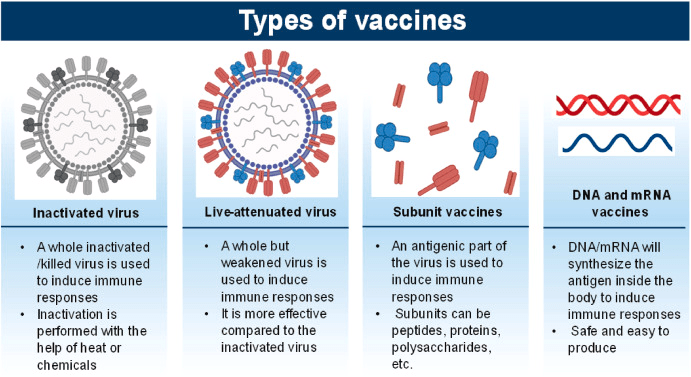
Figure 1: The four different vaccine types used to vaccinate against viral infections. From https://www.sciencedirect.com/science/article/pii/S1773224725003636, licensed under Creative Commons Attribution 4.0 International License
One issue with vaccines in the past has been that a suitable vaccine platform had to be discovered for each new pathogen that emerged. This is similar to the artisanal design of artwork, food, and media where each new design process starts from square one and follows a different path to the final product. Sometimes, a live attenuated vaccine approach would work for one pathogen, but it wouldn’t work for another. This trial and error approach takes time, energy, and resources that could be used on a modular platform instead. For example, one benefit of the mRNA vaccine platform is that it’s adaptable to many different types of pathogens. As long as a subunit of the virus or bacteria can be identified as capable of causing an immune response, the vaccine can be quickly designed and disseminated. This flexible platform allows for rapid response to emerging diseases. Instead of starting at square one like in an artisanal approach, the modular design creates a “plug and play” assembly line in which each new vaccine can follow the same design and manufacturing protocols.
This new flexible platform for vaccine design has emerged on the heels of mRNA vaccines: viral vector vaccines. Surprisingly, they look very similar to the vaccines of the past. Like mRNA vaccines or subunit vaccines, they use one or more pieces of the pathogen that are known to generate an immune response. While this approach is currently being used to design vaccines for many emerging and re-emerging viruses, one instance of its use has been approved by the United States Food and Drug Administration (FDA) for vaccination against a strain of Ebola virus.
The viral vector or backbone used for this vaccine platform is vesicular stomatitis virus (VSV). Like in a car assembly line, this virus acts as the main body of the car, and the only thing that needs to be changed out for each new viral pathogen is the steering wheel. VSV typically infects animals such as cattle, horses, and pigs, but it can infect humans if they come into contact with an infected animal, though transmission is rare. VSV is a good choice for a vaccine backbone because humans don’t have pre-existing immunity to this virus unlike other viral vectors like adeno-associated virus (AAV). Although this vaccine approach uses live VSV, it doesn’t cause the disease associated with the virus thanks to an elegant use of genome editing.
VSV’s own glycoprotein or envelope protein is removed and substituted by the glycoprotein from Ebola virus which acts as the steering wheel of the newly minted car (Figure 2). The envelope protein is the part of a virus that sits on the outside of the virus and interacts with cells and is detected by the immune system. Once this virus is modified, it can be given to individuals as a vaccine. Because the human immune system will be exposed to the Ebola virus envelope protein, it will be able to mount an immune response against it. Moreover, the VSV itself cannot replicate and cause disease in an individual because its genome has been edited.
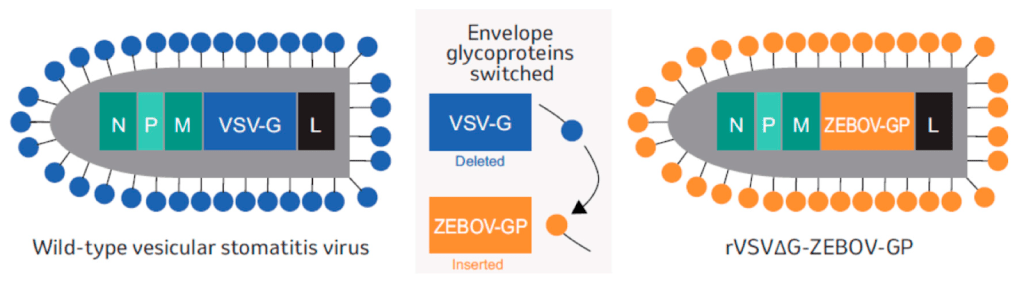
Figure 2: The vesicular stomatitis virus (VSV) and how it is modified for the viral vector vaccine platform. The envelope protein of VSV is removed and replaced by the envelope protein of Ebola virus. From https://www.mdpi.com/2076-393X/8/4/779, licensed under Creative Commons Attribution 4.0 International License
By changing the design process of vaccines from artisanal, time-consuming, and expensive to a modular, “plug and play” assembly line process, the global community will be better able to respond to emerging and re-emerging pathogens.
Edited by Sarah Lester and Jameson Blount




Leave a Reply