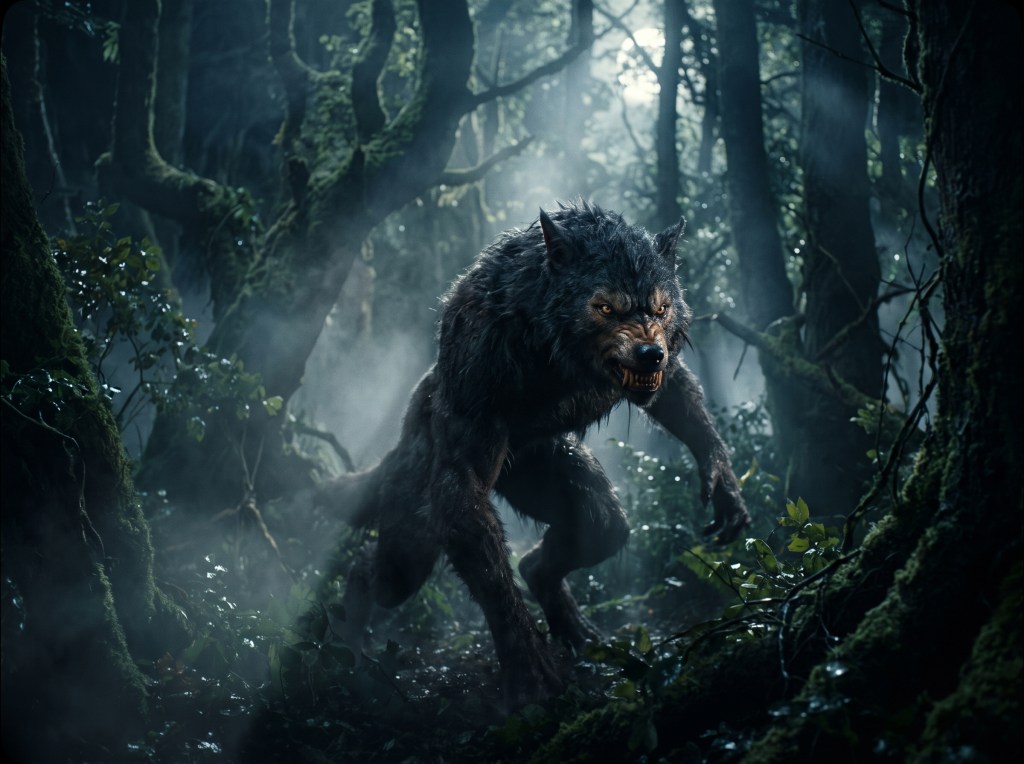
Throughout this series, we have examined genetics stories that sit just beneath the surface of what we teach in science class, and how those stories shape the world outside the classroom. With Halloween around the corner, today’s story is about monsters, and an uncomfortable truth: they are rarely born. More often, we create them.
When I began this series, I shared Ted Aoki’s call that science must be taught as a humanity. That idea is the reason this series exists, and it is central to what I advocate for in science education: when we strip the humanity out of science, we lose more than context. We lose the ability to see how science is used–and misused–on real people.
I know an incredible English teacher; we recently discussed how her teaching team has approached “fear” as an interdisciplinary concept this month (in honour of Halloween). Knowing my writing, she brilliantly pointed out that many of the monsters we read about are based on real people with misunderstood genetic conditions. Our human nature tends to see differences and create monsters. Those who have read my work know that I am a sucker for a good story, and I always appreciate her case for literature: reading stories is how we come to understand human nature. Post-colonial literary scholar Edward Said discussed how Europe imagined the “exotic” East: in describing others, we are really describing ourselves, and the ones doing the describing hold the power. Similarly, Jerome Cohen discusses that monsters embody a culture’s fear of difference. I would argue the monsters in our stories have always said more about their creators than about the monsters themselves.
That conversation crystallized something for me. Monsters are things we create, often despite a scientific explanation sitting right in front of us. In past posts, I have written about genetic essentialism (here, here, and here), the flawed idea that who we are is fixed in our genes. Essentialism shapes our opinions about other people, and sometimes it decides who gets to be human at all. Today, we look at hypertrichosis, often called “werewolf syndrome,” to see how a genetic difference became a monster.
The Story: The Wild Gentleman of Tenerife
Let me tell you a story.
In the mid-1500s, a boy named Pedro González was born on Tenerife, in the Canary Islands, with long, dark, fine hair covering his face and body. As a child, French privateers captured him and sent him to King Henry II of France as an extravagant gift. Renamed Petrus Gonsalvus, he became a royal experiment: could a “wild man” be civilized? He was given fine clothes and elite tutors, and he impressed visitors with his flawless Latin.
Petrus married, and several of his children inherited his condition. Some of them were later handed to aristocrats as gifts. His biographer described the family as “neither captured nor free.” Their portraits hung among the “wonders of nature” in the cabinet of curiosities at Ambras Castle in Austria, and in one natural history book of the era, they were the only humans pictured.
Educated, married, and fluent in Latin, Petrus was still filed away with the curiosities. In 1993, the condition even took its scientific name from that collection: Ambras syndrome.

Ambras Castle
The Science: A Gene in the Wrong Neighbourhood
So what is hypertrichosis? It is excessive hair growth, over the whole body or in patches, that is either present at birth (congenital) or develops later in life (acquired). Acquired forms are usually caused by medications, while congenital forms are genetic and extremely rare.
Humans have roughly the same hair follicle density as chimpanzees. Most of our follicles simply make fine, nearly invisible vellus hair. In Ambras syndrome, those same follicles produce longer and usually darker hair across the body. Nothing foreign has been added. The follicles are just receiving different instructions.
Recall that nearly every cell carries the same DNA but uses only some of its genes, as we saw when we explored epigenetics. Which genes switch on, and where and when, is controlled by stretches of DNA called regulatory elements. Some sit beside their gene, while others sit hundreds of thousands of base pairs away and reach it as the DNA folds. Think of a lamp wired to a dimmer switch down the hall. Cut the wire, and the lamp still works, but the switch no longer reaches it. This is a position effect: a change in a gene’s expression caused by moving it relative to its usual surroundings.
Columbia geneticist Angela Christiano, who began studying hair after her own diagnosis with alopecia areata, found exactly this. In 2008, her lab showed that in one patient with Ambras syndrome, a segment of chromosome 8 had flipped end to end (an inversion), with a breakpoint more than 7 million base pairs from a gene called TRPS1. The gene was intact, but its expression dropped. TRPS1 codes for a transcription factor, a protein that switches other genes on and off, including genes that control how hair follicle cells divide.
In 2013, the same lab studied a large Mexican family with X-linked hypertrichosis. This time, a 389,000-base-pair DNA segment from another chromosome was inserted into the X chromosome, lowering expression of a distant gene, FGF13, in the hair follicle. Because the trait is dominant and X-linked, it leaves a pattern students can trace on a pedigree: an affected father passes it to all of his daughters and none of his sons.
In both families, the genes were encoded correctly. They had simply been moved.
The Genetics Connection: Essentialism Makes the Monster
This is where genetic essentialism takes over the story. Essentialism tells us that a visible trait reveals something fixed and fundamental about who a person is. Applied to hypertrichosis, a change in hair growth became a change in nature: part human, part animal.
Science did not automatically correct this. Julia Pastrana, an Indigenous singer and dancer from Sinaloa, Mexico, was advertised as “the Nondescript.” Darwin wrote that she had a double set of teeth giving her a “gorilla-like appearance,” when in fact her gums were enlarged. After she died following childbirth in 1860, she and her infant son were embalmed and exhibited for more than a century.
Other monsters followed the same script. In 1985, a Canadian biochemist suggested vampire legends came from porphyria, a group of rare blood disorders. Critics called it a “medicalization of a myth,” and real patients were taunted as vampires. This was not sound science. It was essentialism wearing a lab coat. Despite these examples being quite sensationalist, it is not really any different than the essentialism used to harm black women as the science of gynecology was developed, or the medical racism experienced by Henrietta Lacks that still has chilling effects on marginalized populations today. Even when looking at cases of female Olympic boxers being labeled as pariahs due to a flawed understanding of genetics, it is easy to see that society creates fictitious monsters out of anything and misuses science to support its flawed views.
The Humanity Link: What Literature Knows
This brings me back to the brilliance of the English teacher. Literature has explored monsters for centuries, and the word itself explains why. “Monster” comes from the Latin monstrum, an omen or warning, rooted in monere, “to warn.” A monster is something we point at.
Mary Shelley understood this in 1818. In Frankenstein, the Creature learns to read, studies Milton, and longs for a family, yet everyone who sees him screams, flees, or attacks. Eventually he tells his maker: “I was benevolent and good; misery made me a fiend.” Shelley even gives him the narration for part of the novel, a chance the historical record rarely gave Petrus or Julia. And over time, we started calling the Creature by his maker’s name.
To me, this is what it looks like to teach science as a humanity. Literature teaches students to ask who is telling the story, whose voice is missing, and what a label is doing. Those are scientific questions too. Students can study position effects in biology, read the Creature’s chapters in English Language Arts, and ask the same question in both: is the difference in the body, or in the story we tell about it?
The Point: Burying the Monster
Julia Pastrana’s story has a final chapter. After a ten-year campaign led by Mexican artist Laura Anderson Barbata, Pastrana was buried in her home state of Sinaloa in February 2013, according to the traditions of her faith. Barbata didn’t change a single gene. She changed the story.
That is what scientific literacy, paired with humanistic literacy, can do. A student who understands a position effect sees through the “werewolf” to a person whose follicles got different instructions when a stretch of DNA moved. A student who reads Frankenstein learns to ask who is doing the pointing, and why.
This Halloween, many of us will dress up as monsters for a night. Petrus, his children, and Julia were cast as monsters for a lifetime, and in Julia’s case, long after. The monster was never in their genomes. It was in the stories we told about them, and it’s up to us to tell better ones.
Pay attention in English class, you science nerds.
Class dismissed.
Thanks, Benny, for your bewitching impact on my story, and for co-authoring a story with me.
Edited by: Katherine Cardwell, Claire Wilson, Amanda N. Weiss
Ambras Castle Photo (courtesy of Pexels):



Leave a Reply