Parrots display dramatic colors, from the famous green and red, to the less familiar blue, yellow and brownish tones. Although acknowledged as genetically inherited, the genes resulting in these differences are not yet fully understood.
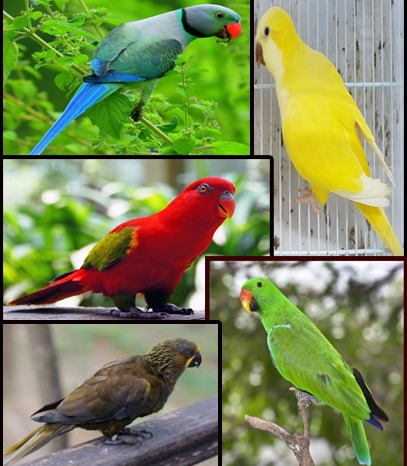
Parrot images sources:
[images have been cropped along with scaling ratios changed]
yellow (https://commons.wikimedia.org/wiki/File:Monk_Parakeet_Bird.jpg), green (https://commons.wikimedia.org/wiki/File:Green_Parrot_Cairns-1and_%284197620649%29.jpg), brown (https://commons.wikimedia.org/wiki/File:Parrot_mostly_brown_%2825055668240%29.jpg), red (https://www.flickr.com/photos/volvob12b/9850748465), blue (https://www.pexels.com/photo/a-parrot-perched-on-green-plant-6055650/)
From a parrot’s perspective, life is meant to be lived colorfully.
Parrots (Psittaciformes) are many-hued and among the most flamboyant birds in the feathered kingdom. In many avian species, feather colors have evolved primarily to attract mates. However, pigmentation responsible for such coloration is also important for protection from harmful ultraviolet (UV) radiation by acting as a built-in sunscreen, as well as to maintain body temperature by absorbing heat.
It is well-known that pigments such as melanin play an active role in imparting a variety of shades in birds and animals. Even so, C.F.W. Krukenberg discovered that parrots are unique as they naturally possess pigments called psittacofulvins within their feather keratins (keratins are structural proteins lining body surfaces to form protective layers and support pigmentation).
Psittacofulvin Pigmentation:
The mechanism underlying psittacofulvin pigmentation was quite unclear to scientists for a long time, because unlike parrots, other birds like chickens, pigeons and quails derive their coloring pigments (called carotenoids) through plant-based dietary intake.
Subsequently, Cooke TF, et al. announced an enzyme called polyketide synthase (PKS) to be involved in the synthesis of yellow psittacofulvins.
Interestingly, Roy SG, et al. explain that the most commonly noticed green plumage in parrots is not due to any green pigment; rather the color green is rendered when yellow psittacofulvins combine with blue color generated by the feather structure. This blue arises when light is scattered through micro-structures in feather barbs (spongy layer) containing dark melanin granules, particularly eumelanin.
Further, a study by Ke F, et al. in budgerigars (‘budgie’ pet parrots) demonstrated that when yellow psittacofulvins are absent, due to mutations in the PKS gene, the structural blue directly results in blue plumage.
Additionally, Arbore R, et al. discovered that an enzyme called aldehyde dehydrogenase, encoded by the gene ALDH3A2, regulates the shift between yellow versus red psittacofulvins on a chemical basis in developing feathers. Focusing on a species called dusky lory, which has wild populations with both red and yellow plumage, the researchers inferred that higher ALDH3A2 activity during development produced more yellow, whereas lower activity favored red.
Eumelanin Synthesis & Role of Tyrosinase Enzymes:
As mentioned above, in the case of parrots, eumelanin works in tandem with feather structures. Delving deeper, Roy SG, et al. found that two key glyco-enzymes (enzymes with sugar residues, essential for cellular functions), tyrosinase (TYR) and tyrosinase related protein 1 (TYRP1) control eumelanin production, which in turn gives rise to diverse coat colors.
Eumelanin is synthesized via a process called melanogenesis which occurs in specialized cells called melanocytes. Enzyme TYR initiates the process by converting an amino acid called tyrosine into melanin precursors called dopaquinone. Enzyme TYRP1 later guides the pathway towards eumelanin.
[On the same lines as earlier analytical studies by de Oliveira Neves AC, et al., Roy SG ’s team too confirmed that parrots do not use pheomelanin (causing reddish-brown in many other birds and animals), hence their coloring depends solely on variations in the intensity of eumelanin (brown to black).]
Since parrots are sought after as popular pets, selective breeding has amplified similar color tuning across the psittaciforme species. Accordingly, Roy SG, et al. recognized two notable color traits within the captive-bred populations, arising from mutations in either TYR or TYRP1 genes:
The first was a lutino-like trait, where birds appeared bright yellow instead of green. Examining the DNA in species like Fischer’s lovebirds and green-cheeked parakeets exposed mutations in the TYR gene that severely diminished or completely blocked ‘tyrosinase activity’. As a consequence, eumelanin was not at all made and feather structures could no longer create the blue component needed for green coloration.
The second trait was the cinnamoncolor morph, observed in rose-ringed parakeets, where feathers appear lighter, browner, or softer in tone. In this situation, mutations were detected in the TYRP1 gene. Unlike TYR mutations, these changes did not stop melanogenesis entirely. Instead, they reduced the extent of melaninization, leading to weaker or lighter eumelanin that affected the feather’s ability to generate the strong structural blue. So, fine green feathers became paler or brownish, giving a cinnamon-like appearance.
Even when melanin is produced, mutations in SLC45A2 (a transporter protein that’s necessary to transfer melanin from melanocytes into feather barbs), can spur a loss of the blue structural color owing to ineffective melanin deposition or total absence of melanin in the spongy layer, thereby leaving only yellow psittacofulvins. (Roy SG, et al.)
Conclusion:
These reports collectively emphasize how genotypic changes / mutations in single genes can alter enzyme functions, resulting in strikingly visible physical / phenotypic changes.
TYR and TYRP1 are conserved in many mammals such as rabbits, cats, dogs, cattle and humans, where they regulate hair, skin and eye color. Therefore, learning about parrot plumage offers broader insights into the shared evolutionary patterns regarding pigmentation across species.
The multi-species genetic and functional conservation can be effectively leveraged to extrapolate crucial findings about specific disorders from other species to humans.
For example, investigating mutations in the tyrosinase genes suggest that they can cause albinism, a condition characterized by reduced or absent melanin production (Roy SG, et al.), and could even contribute to the development of melanoma, a skin cancer associated with UV-induced DNA damage in melanocytes (Balogh AA, et al.).
Edited by: Zach Patterson and Amanda N. Weiss

 GeneBites
Leave a comment