A good song depends on more than hitting the right notes. It depends on timing. Somewhere in the background, a metronome keeps the beat steady so everything else can fall into place. New research suggests that in your gut, a quiet population of cells may be keeping time.
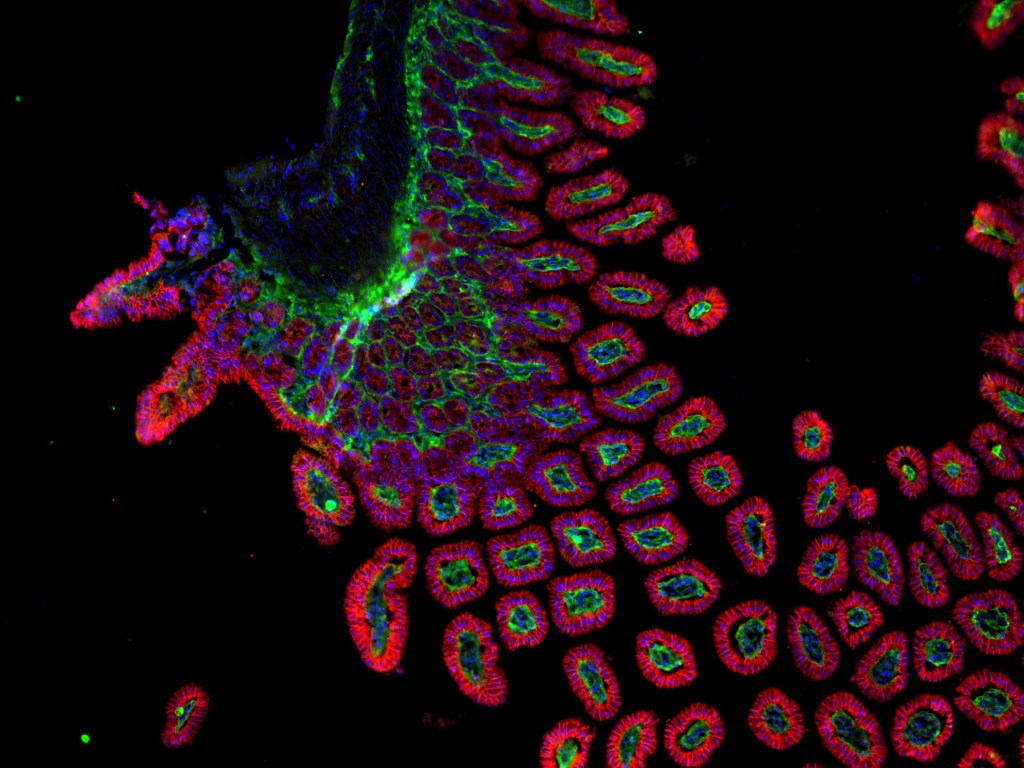
Even when you are not eating, waves of muscle contraction move through meters of intestinal tissue, gently squeezing and releasing to push contents forward. This motion, called peristalsis, happens without conscious control, giving it an almost mechanical rhythm. For decades, scientists assumed neurons alone were responsible for setting the tempo: neurons fired signals, muscles contracted, and the gut moved. A new study suggests that picture is incomplete.
The gut is often called the body’s “second brain” because it contains its own dense network of neurons, known as the enteric nervous system. But neurons are not alone there. They are surrounded by enteric glial cells — non-neuronal cells whose name comes from the Greek glía, meaning “glue.” For much of modern biology, this reflected the belief that the job of glial cells was simply to hold neurons together.
That assumption echoes an older story from neuroscience. For much of the twentieth century, glial cells in the brain were thought to be passive support. Only in the past few decades did researchers discover that they actively shape signaling, synchronize activity, and influence how neural circuits function. Whether gut glia play similarly active roles in digestion has remained an open question.
In a study* from Case Western Reserve University, Dr. Marissa Scavuzzo and a team of resarchers took a closer look at these long-understudied cells. By examining which genes were active in tens of thousands of individual cells from the adult mouse intestine, the team discovered that enteric glia are not a single, uniform group. Instead, they come in distinct subtypes, including a rare population the researchers call “enteric glial hub cells.”
These hub cells stand out for two reasons. First, they are found primarily in the muscle layer of the intestine, where movement is generated. Second, they are enriched for a protein called PIEZO2, which allows cells to sense physical force. As food stretches and presses against the gut wall, mechanical forces spread through the tissue. PIEZO2 gives cells a way to detect those forces.
To test whether enteric glial hub cells actually respond to mechanical pressure, the researchers turned to a custom “intestine-on-a-chip” system. This setup allowed them to gently stretch intestinal tissue while watching enteric glial cells in real time using calcium imaging, a common way scientists track cellular activity. When pressure was applied, a subset of glial cells responded with bursts of calcium signaling. When PIEZO2 was blocked or genetically removed from these cells, those calcium responses disappeared.
The consequences were visible at the scale of the whole organ. Mice lacking PIEZO2 in enteric glia still showed muscle contractions, but the timing of those contractions became irregular. The normally smooth, wave-like motion of the intestine fell out of sync, and food moved more slowly through the digestive tract.
Importantly, the muscles themselves were still capable of contracting, and the neurons were still present. What was missing, however, was coordination.
Rather than acting as command centers, enteric glial hub cells appear to fine-tune how neurons and muscles respond to mechanical forces inside the gut. By sensing stretch and pressure and triggering calcium signals, these glial cells help adjust communication so that contractions unfold in a properly timed sequence. Mechanical force, glial sensing, neuronal signaling, and muscle contraction all feed into one another to produce steady movement in harmony.
The idea that glial cells help synchronize activity may sound familiar. In the brain, a type of glia called astrocytes also use calcium signaling to influence neural timing. These parallels suggest that similar cellular strategies help regulate timing across different organs — not to generate thoughts, but to keep physical systems running smoothly.
This perspective also reframes digestive disorders. Conditions involving chronic constipation, delayed gastric emptying, or irregular gut movement are often blamed on faulty nerves or weakened muscles. This study raises the possibility that disruptions in glial sensing and coordination may contribute to these problems.
Enteric glia are known to respond to inflammation, stress hormones, and microbial signals, all of which are factors linked to gut health. If glial cells help adjust the timing of intestinal movement, then stress and immune activity may influence digestion not by stopping motion outright, but by knocking it off beat.
More broadly, the study hints at a shared strategy the body may use to keep time across many organs. From astrocytes shaping neural rhythms in the brain to enteric glia coordinating contractions in the gut, glial cells may serve as quiet conductors, aligning the tempo of biological systems whose failure can ripple outward into disease.
For more than a century, glial cells have carried a misleading label: “support cells.” Studies like this one continue to challenge that view. In the gut, glia do not fire electrical impulses or generate contractions. But by sensing force and shaping communication, they help keep the rhythm steady. Your intestines don’t move because neurons issue commands alone. They move because many cells listen to the same beat, and when the gut keeps time, enteric glia may be the metronome quietly ticking in the background.
*This study was posted on bioRxiv, a preprint server, and has not yet undergone peer review.
Edited by Amanda N. Weiss and Jayati Sharma, PhD


 GeneBites
Leave a comment