The ocean is full of biodiversity; however, with no apparent geographic barriers to initiate speciation we do not fully understand how new species form in the ocean. Blue bottles shed some light into this process as they passively drift across the ocean.
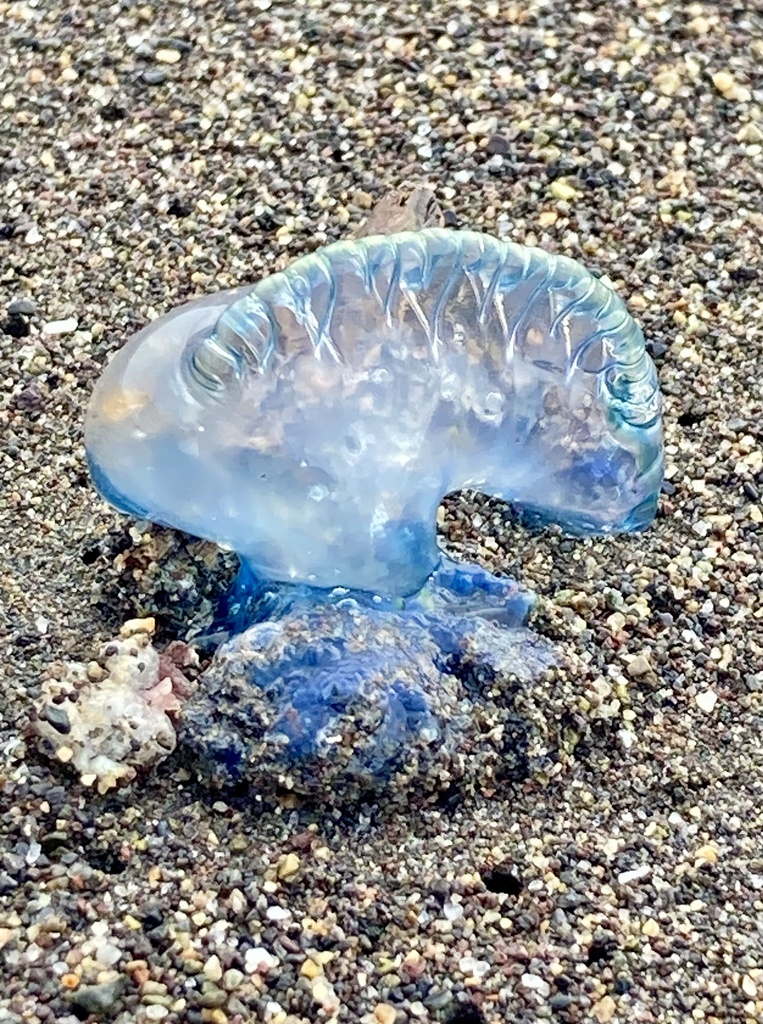
An IndoPacific bluebottle, Physalia utriculus, off the coast of Colima, Mexico. Image obtained from INaturalist from user, Christian_eduardo_topolino.
Sailing across the ocean in search of a fishy meal is a blue jellyfish-looking creature known as the bluebottle. Unlike true jellyfish that use ocean currents to drift as individual medusas, bluebottles are classified as siphonophores and travel together using a muscular crest to “sail” across the ocean surface as a group, with each individual performing a specialized task such as reproduction, prey capture, or digestion. This unique adaptation allows them to move through the surface of the open ocean, and even occasionally sting the occasional oceangoer with their venomous harpoon-like stinging cells.
With their unique ability to drift on surface currents across oceans, bluebottles are well-traveled ocean dwellers, leading researchers to assume their populations are interconnected, and thus, have high gene flow. This assumption implies that there is constant introduction of new genetic material into the bluebottle gene pool through migration. This type of population is called a panmictic population, and researchers have long thought that all ocean populations demonstrate this kind of constant gene flow.
Although bluebottle populations are considered panmictic populations, researchers have noted differences in body part sizes within different ocean regions. This finding drove researchers in a 2025 Current Biology paper to test the hypothesis that there are distinct populations of bluebottles in different ocean regions and that these populations have distinct morphologies.
Researchers collected bluebottle specimens, mostly from the Yale Peabody Museum, and sequenced 151 samples that spanned the Atlantic, Pacific and Indian Oceans. They were able to map and compare these sequences utilizing a newly developed bluebottle genome as a reference. Population genetic analysis revealed, for the first time, that bluebottles are composed of five genetically distinct populations based on oceanic region!
The authors verified these results by testing the amount of heterozygosity present in the presumed subpopulation compared to the heterozygosity in the total bluebottle population. This test uses the fixation index known as FST and essentially determines how different the two populations are at a genetic level If values are near zero, the two populations do not differ greatly from each other and likely interbreed regularly. A near zero value would confirm scientists’ original hypothesis that bluebottle populations across ocean regions mix frequently. However, researchers in this study found that the genetic clusters had index values as high as 0.54 FST values between them, which indicates significant genetic differences in bluebottle populations. This finding was further confirmed through phylogenetic trees. that showed distinct genetic clusters.
Researchers then associated four distinct body shapes to the five distinct populations utilizing a large participatory dataset of photos through INaturalist. They found a unique bluebottle body shape for four of the distinct populations with the fifth population still requiring further research to identify its unique body shape.
If you ever have the pleasure of encountering this blue ocarina with curly fries, likely when they wash up on beaches, know that you may be encountering one of the four populations that were recently identified. This study adds to our knowledge that there is even more diversity and population differentiation happening in the ocean than we once thought.
Edited by Ethan Honeycutt & Jayati Sharma

 GeneBites
Leave a comment