A recent study identifies accumulation of a certain protein filament as a hallmark of brain aging, which can be targeted to improve aging health. Furthermore, it links this accumulation with disruption of a vital cellular process, providing insight into how the brain changes with age.
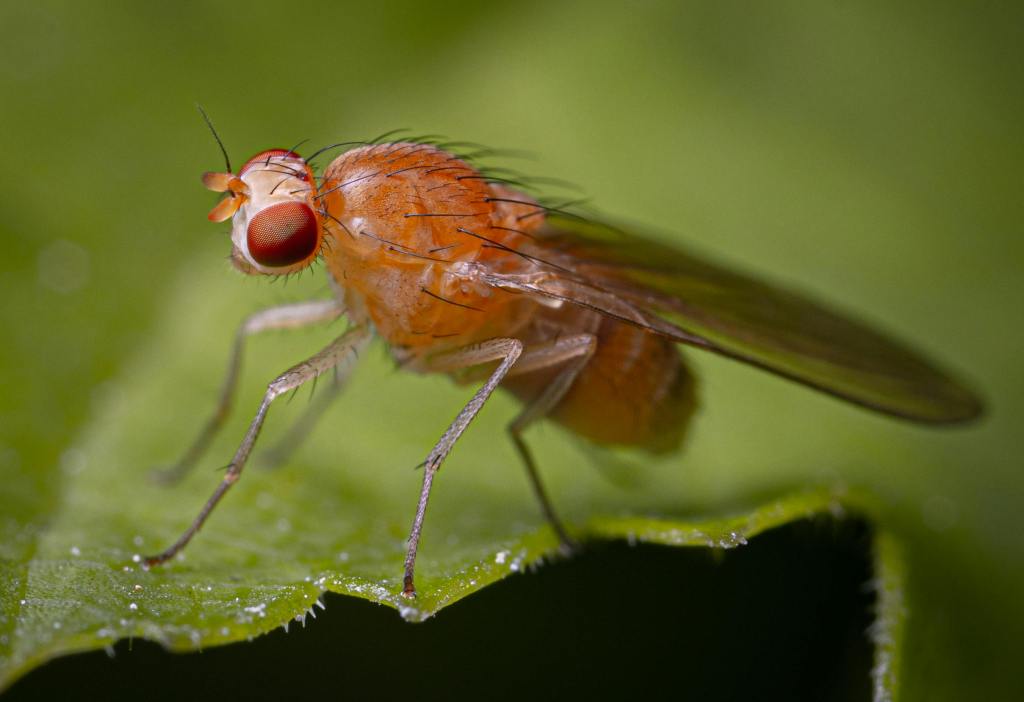
Image from Pexels.
At first glance, humans have very little in common with fruit flies, but did you know that many fruit fly genes are actually found in similar forms in humans? In fact, approximately 75% of the genes that cause disease in humans can also be found in fruit flies. This means that studying biological processes in the fruit fly can often provide insight into human biology. For instance, scientists have used fruit flies to study nearly everything, from basic biological processes like cell division and cell signaling to diseases like cancer and diabetes. Interestingly, a recent paper even uses fruit flies to gain insight into the process of aging.
This study, by Schmid et. al., builds on previous work that shows that aging is associated with changes related to the cytoskeleton. Found within the cytoplasm of a cell, the cytoskeleton is a network of protein fibers that acts as a sort of scaffold for the cell, helping to maintain its shape and structure. The cytoskeleton also plays a role in various cellular processes, such as cell division and movement. It is composed of three different protein fibers, one of which is called actin. There are two forms of this protein: globular actin (G-actin) and filamentous actin (F-actin). Globular actin acts as the building block for long actin filaments (F-actin). Actin filaments are constantly being assembled and disassembled, and past studies have shown that disruption of these dynamics is associated with aging. However, before publication of this new paper, this association was not well characterized in the context of the brain. Thus, this paper specifically focuses on the role that actin dynamics play in the process of brain aging.
To start, the researchers used microscopy to visualize F-actin in the brains of aging flies. They found that total F-actin levels increased significantly with age. This change was especially prominent in the optic lobes of the brain, where they found F-actin-rich rod-like structures in aged flies that were not present in young flies. The next step was to determine whether or not these rods were indicative of aging health. To answer this question, the researchers fed flies a low-protein diet or treated flies with a small molecule called rapamycin, both of which are known to increase lifespan. When the researchers imaged the brains of these flies, they found significantly fewer F-actin-rich rods than in untreated flies of the same age. This indicates that not only does F-actin accumulate in the fly brain as it ages, but also that this accumulation may be reflective of the animal’s health.
This led the researchers to ask what effect reducing F-actin levels in the brain would have on the flies’ health. To answer this question, they used a technique called gene knockdown. This technique allows scientists to reduce the expression of a given gene in specific cells at a specific time. In this paper, the authors knocked down the gene Fhos in all neurons. Because Fhos is important for the assembly of actin filaments, reducing its expression in neurons decreases the amount of F-actin in the brain. The authors could then compare the health of knockdown flies with that of control flies by measuring known markers of health, such as lifespan, locomotor activity, climbing endurance, and nighttime restlessness. Interestingly, the knockdown flies not only lived longer than the control flies, but also showed improvements in other health parameters. For example, knockdown flies showed improved locomotor activity and climbing endurance as well as less nighttime restlessness compared to control flies. This suggests that reducing F-actin levels in the brain not only increases lifespan, but also improves healthspan.
However, the researchers still wanted to understand the mechanism by which F-actin accumulates with aging and how its reduction benefits health. Previous work has shown that actin dynamics play an important role in a process known as autophagy. The word autophagy literally means “self-eating” and refers to the process by which cells break down and recycle cellular waste, such as old or damaged components of the cell. Defects in this process are considered a hallmark of aging and lead to accumulation of cellular waste within cells as they age.
Given that autophagy plays this role in aging and that actin dynamics play a part in various steps of autophagy, the authors wanted to examine the interplay between F-actin accumulation and autophagy during aging. As expected, autophagic activity decreased with age in control flies. However, Fhos knockdown flies showed autophagy levels similar to those of young controls. Additionally, treating aged flies with cytochalasin D, which breaks down actin filaments and is able to stop age-associated F-actin accumulation in fly brains, also restored autophagy levels to those seen in young controls.
Interestingly, similar results were also seen when the authors looked specifically at autophagy of mitochondria (mitophagy). As expected, mitophagy also decreased with age in control flies. Because of this, aged flies had an accumulation of mitochondria in their brains, and these mitochondria functioned more poorly than those in the brains of young flies. However, knocking down Fhos or treating flies with cytochalasin D restored mitophagy levels. Furthermore, it decreased the accumulation of mitochondria in the brain and restored mitochondrial function. Together, these results suggest that age-associated F-actin accumulation impairs brain autophagy and mitophagy, and this is perhaps the mechanism by which this accumulation affects aging health.
To test this hypothesis, the researchers combined knockdown of Fhos with knockdown of a gene called Atg1, which plays an important role in autophagy. Knocking this gene down inhibits this process. Therefore, the brains of flies with neuronal knockdown of both Fhos and Atg1 not only have reduced F-actin accumulation, but also reduced autophagic activity. In contrast to the results seen with Fhos knockdown alone, flies with both genes knocked down showed no increase in lifespan or healthspan. Furthermore, the improvements that were seen in Fhos knockdown flies in mitochondria accumulation and function were absent in the double knockdown flies. Altogether, these results suggest that the health benefits of Fhos knockdown are dependent on autophagy. This supports the hypothesis that age-associated F-actin accumulation drives brain aging and related health decline by disrupting autophagy.
Overall, this paper provides valuable insight into the process of aging in the brain. It establishes accumulation of F-actin as a hallmark of aging that can be targeted to improve aging health. It also links age-associated F-actin accumulation with disruption of autophagy. While more work is needed to translate these findings into humans, this study is a useful first step into understanding how the brain ages.
Edited by Amanda N. Weiss and JP Flores


 GeneBites
Leave a comment