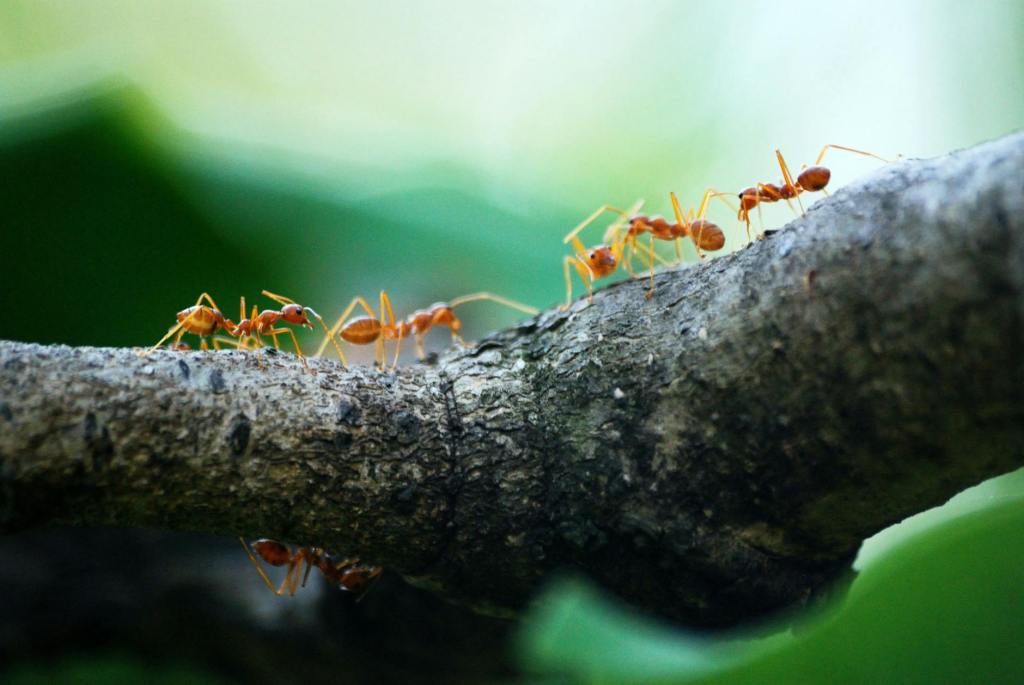
New evidence shows that African Matabele ants societies can serve as ‘wound healing’ paramedics. Scientists are now exploring how these potent antibiotics may defend humans against deadly superbugs.
Ants are known to be the Tiniest Guardians of their miniature territory, and like humans, they also have to guard themselves against the pathogenic bacteria that cause diseases. A new study led by two researchers — Clint Penick, an Assistant Professor at Arizona State University and a Postdoctoral Scientist at North Carolina State University — found that around 40% of ant species can produce powerful antimicrobial agents. A marvellous antidote that has promising potential to be tested in humans to guard themselves against some life-threatening pathogens.
“One species we looked at, the thief ant (Solenopsis molesta), had the most powerful antibiotic effect of any species we tested – and until now, no one had even shown that they made use of antimicrobials…..” says Adrian Smith, co-author of the paper, an Assistant Research Professor of Biological Sciences at NC State and head of the NC Museum of Natural Sciences’ Evolutionary Biology & Behavior Research Lab.

Source: https://www.dreamstime.com/stock-photos-ant-team-work-image1248953. Modified in Biorender.com
Scientists collected around 20 ant species and tested their antimicrobial properties by taking solution from each ant’s outer shell and tested their antibiotic potential on bacteria. The growth of the bacteria in an ant solution was compared to their counterparts in a control group; if their growth in ‘thief ant’ (Solenopsis molesta) solution was less than those in a control group, the tested antimicrobial was conferred to be effective against bacteria.
“We thought every ant species would produce at least some type of antimicrobial,” Penick says. “Instead, it seems like many species have found alternative ways to prevent infection that do not rely on antimicrobial chemicals.”
Surprisingly, the team of researchers found that the thief ant has stronger antimicrobial properties than the fire ant-Solenopsis invicta.
“Next steps include testing ant species against other bacteria; determining what substances are producing the antibiotic effects – and whether ants produce them or obtain them elsewhere; and exploring what alternative strategies ants use to defend against bacterial pathogens,” Smith says.
In 2024, a study led by scientists from Würzburg and the University of Lausanne revealed the biochemical profiling on the wound-healing ability of Matabele ants (Megaponera analis) following an injury during their encounter with their interbreeds, the termites. Chemical analysis conducted by JMU Professor Thomas Schmitt showed that M. analis relies on the metapleural gland (located in the thorax) to perform ‘medical wound treatment’ and of 112 compounds discovered, half of which have potent antimicrobial properties.
Despite this groundbreaking discovery, it is not yet known whether the same antimicrobial agent would work against other bacterial strains or whether Ants are the direct source of these newly discovered antimicrobials.
Thus, all these fascinating discoveries led us to further understand the dawn of evolution of life- Matabele ants emerging as nature’s own antibiotic reservoirs- Warriors and Healers in the insect kindgom. There was a time when antibiotic drugs were used to combat bacteria found in soil. Similarly, ants use related bacteria to produce powerful antibiotic substances can potentially save the lives of humans against such hazardous superbugs.
The Ant Warrier: Guardians of Humans against life threatening Superbugs
Many novel approaches are underway to tackle the resurgence of antibiotic resistance. Some of the notable projects include CARB-X (Combating Antibiotic-Resistant Bacteria), a global collaboration between academia, industry, and the government that is already taking on the search for new antibiotics against gram-negative bacteria getting funds of around $455 million from the Wellcome Trust and BARDA (Biomedical Advanced Research and Development Authority). Antibiotic resistance breakers (ARB) involve co-administering a non-antibiotic drug with a failing antibiotic. Besides all these innovations, a review in the Lancet said: “tackling antibiotic resistance needs investment somewhere between the Large Hadron Collider, which cost approximately £6 billion, and the International Space Station, which cost £96 billion”.
If further screening on tested Ant species could provide us with a potent and broad-spectrum antimicrobial that could potentially wipe out and combat both bacteria shortly to come, then this nature’s marvel offered by “The tiniest Warriors” could likely cut down a cost burden of Healthcare and Pharma Industries.
Edited by JP Flores & Parvathi

 GeneBites
Leave a comment