Bats’ exceptional immune systems have long puzzled the scientific community. A team of scientists have identified genes that may contribute to their unique viral tolerance.
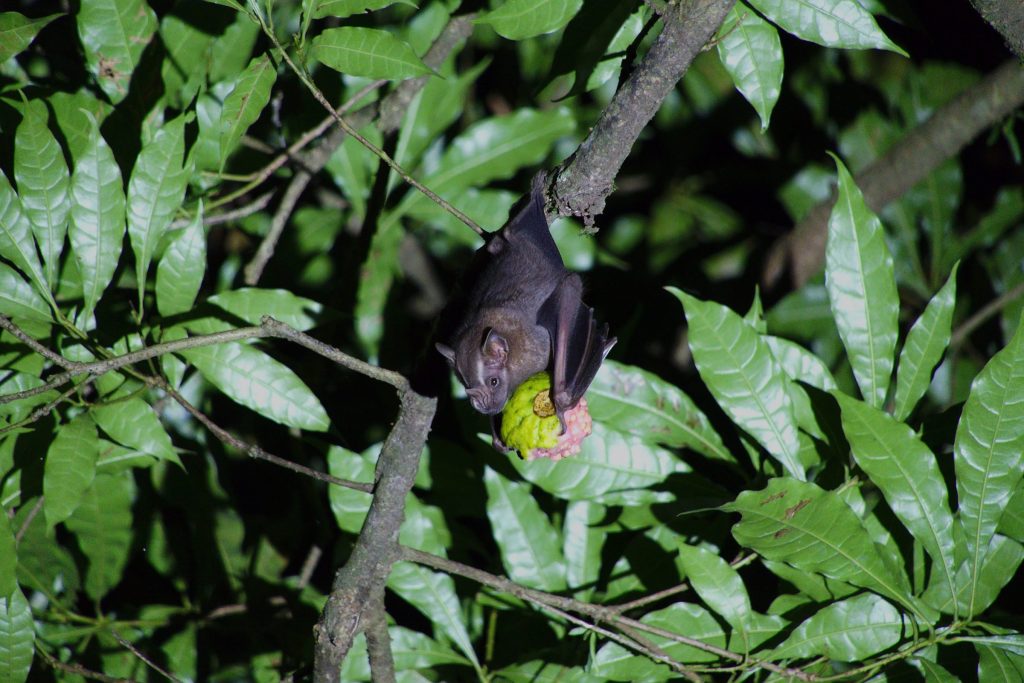
A Jamaican fruit bat snacking on guava in Costa Rica (Photo by Daniel Vontz)
Bats might be the most mysterious mammals on earth – not only can they fly and echolocate, but they also have exceptionally long lifespans and don’t seem to get sick from viruses! We heard a lot about bats during the COVID-19 pandemic as a suspected source of the virus, and there is growing evidence that they are reservoirs for other zoonotic diseases such as the original SARS and Ebola. Although these viruses can be lethal in humans, bats seem to tolerate infection with no obvious disease or mortality.
Bats are also incredibly diverse; with over 1,400 known species on every continent except Antarctica, they are the second most speciose mammalian order behind rodents. They span many dietary niches including insectivores (insect eaters), frugivores (fruit-eating), nectarivores (nectar-eating), piscivores (fish-eating), carnivores (meat-eating), and sanguivores (blood-eating). Pollination, pest-control, and seed dispersal are just a few of the crucial ecological services that bats provide. Such taxonomic, geographic, and ecological diversity means that scientists need to study as many species as possible in order to understand how their unique immune systems may have evolved.
In a recent study published in Genome Biology and Evolution, Dr. Armin Scheben and colleagues attempt to decode bat immune systems using comparative genomics, which is exactly what it sounds like: comparing the genomes of multiple species.
First, they generated new long-read genomes for two species: the Jamaican fruit bat (Artibeus jamaicensis) and the Mesoamerican mustached bat (Pteronotus mesoamericanus). This means that they sequenced longer chunks of DNA, which allows them to study more complex regions of the genome – such as immune genes. Along with 13 additional bat genomes, they identified the most recent common ancestor (MRCA) that all 15 bat species were descended from and compared them to five non-bat mammals (human, mouse, pig, horse, and dog).
From these analyses, Dr. Scheben’s team noticed a shocking contraction, or loss of genes, within the type I interferon (IFN) locus in bats. This locus contains genes that encode antiviral molecules, which help the immune system fight viral infections. It is a large gene family that is highly variable across mammals, and bats are no exception. They found that the bat MRCA lost 9 type I IFN genes compared to the non-bat mammals. A closer look at the genes revealed that these losses were almost exclusively IFN-ɑ genes: bats have 0-4 IFN-ɑ gene copies compared to 10-18 in the non-bat mammals. In contrast, bat IFN-⍵ gene copies were seemingly unaffected. This may indicate that bats have evolved a distinct antiviral immune strategy that relies on IFN-⍵ rather than IFN-ɑ, which could explain their unique relationship with viruses.
Type I IFNs function by activating an array of IFN-stimulated genes (ISGs) to combat viral infection at various stages, such as preventing infection of a healthy cell, blocking viral replication, or triggering cell death to prevent viral spread. The researchers took notice of one such ISG family, the immune-related IFN-induced transmembrane (IR-IFITM) genes, which was expanded in one subset of bats. They also observed evidence of positive selection in IR-IFITMs in the bat MRCA compared to other mammals, meaning that these genes contain beneficial mutations that may contribute to the potent antiviral response seen in bats.
Broader analyses revealed that many other genes are under positive selection, and some are evolving very rapidly. Using gene-ontology (GO) terms, which group genes by biological function, they found that a whopping 27% of positively selected genes (PSGs) were related to the “immune system process.” They further identified PSGs involved in pathogen-sensing and antiviral activity (TLR2, UNC93B1, IL6, PARP9, and IFIT2) as well as DNA-repair and tumor suppression (PALB2, POLA1, POLD1, POLK, POLM, BIK, LATS2, CDH1, and CAT). These findings reinforce the evidence for unique antiviral strategies in bats, and offer new insight into possible mechanisms for longevity and cancer resistance.
We’ve barely scratched the surface of understanding how bats live with their viruses without severe illness. This work highlights the need for high-quality genomes and broad species representation for unraveling the complexities of the immune system. These fascinating creatures might just hold the key to preventing future pandemics and revolutionizing how we fight human viruses!
Edited by Jayati Sharma and JP Flores


 GeneBites
Leave a comment