Where fossil evidence is scarce, researchers use a new technology to recover the organic traces an old ecosystem.

In environments with the right conditions, like the icy glaciers of Greenland, bits of DNA that are millions of years old can be recovered to learn about the plants and animals that once lived there. (Photo by Nidia Dias + Google DeepMind on Pexels)
As beams of sunlight trickle through the lattice of snow-dusted pine branches, a sleeping reindeer awakens in search of some tasty shrubs. A flock of geese honk loudly as they fly in formation overhead. Suddenly, it stops dead in its tracks. Towering above the reindeer stands a mastodon, barely registering the buck’s presence. Seeing the giant’s lack of concern, it hurries back into the forest, feeling fortunate despite its fruitless foraging. Just another morning in Greenland, 2.1 million years ago.
Although we don’t have a way of knowing the morning routine of Greenland’s fauna 2 million years ago, recent discoveries based on some of the oldest DNA evidence suggest a scene like this very well could have. In December of 2022, Eske Willerslev, a geneticist and paleontologist at the University of Cambridge, and his colleagues were able to take samples of ancient permafrost from the Kap København Formation in Northern Greenland. Using a technique that Willerslev developed, the team extracted DNA that was present just in the environment, also known as environmental DNA or eDNA. eDNA comes from organisms that expired or otherwise shed their DNA around their homes. DNA abounds in Greenland’s frozen desert, but researchers have only recently developed a technique to free it intact from its icy prison. Once extracted from the permafrost, the DNA is sequenced to reconstruct ancient plant and animal genomes and compare them to modern flora and fauna.
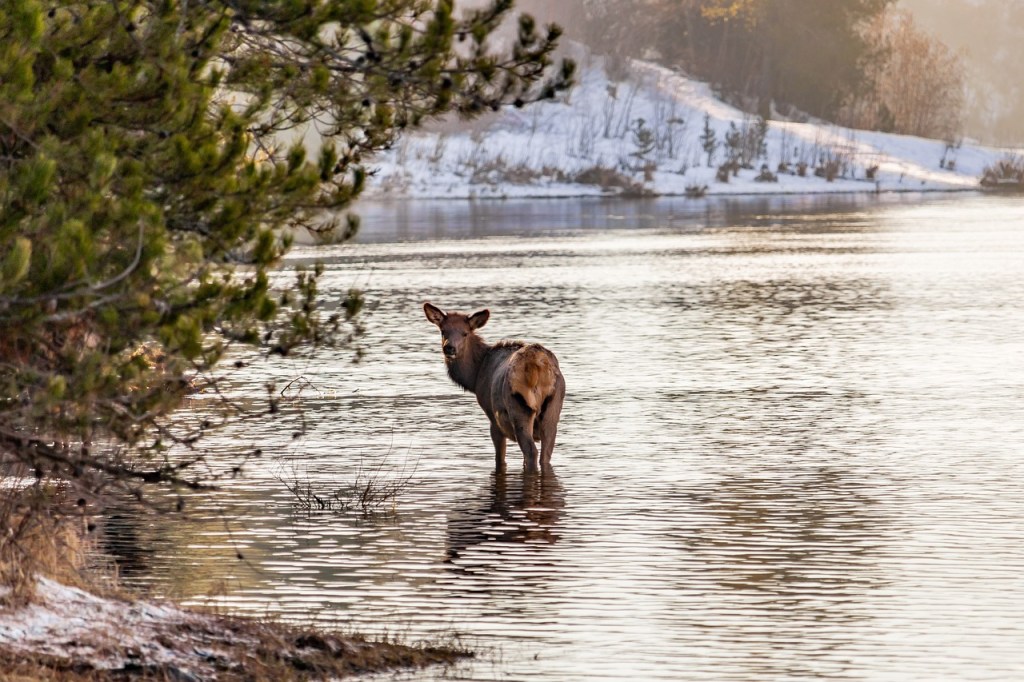
Elk were one of the many creatures found to have lived near the the ancient Kap København Formation in Northern Greenland. (Image by ScatteredBitsOfLights from Pixabay)
The picture the researchers painted was unprecedented. The records showed a mixture of both open boreal and Arctic desert flora and fauna. Although you would probably recognize the reindeer, geese, conifers, and even the mastodons identified as part of this community, the denizens of these chilly environments were not known to have lived together. If you happened to live in Northern Greenland 2.1 million years ago, bumping into a mastodon while looking for breakfast was plausible indeed.
Within the DNA record, the researchers also found the presence of marine animals, including horseshoe crabs and green algae. This discovery is particularly interesting, because these species could not survive in the present-day versions of these frozen ecosystems. Their presence in the DNA record suggests that the climate 2.1 million years ago was warm enough to support life that wouldn’t make it in today’s cooler Greenland. That hotter environment is where the climate of today’s Greenland is headed if the effects of climate change are not mitigated. Understanding the implications of scientific evidence can give us an idea of what to expect for our ever warming planet, and pushes the boundaries of what paleobiology and DNA technology are capable of.
While eDNA can tell us what organisms were present in a particular moment in time, it can’t tell us information about their anatomy and life history like fossils can. Additionally, researchers can only investigate the ecosystem based on the limited evidence they have, which likely represents a mere fraction of the environment’s full diversity. Although the authors seem certain that the DNA they found originated from that area, they do not address the possibility that the DNA could have washed into the formation from another area before preservation. The ability of eDNA extraction to tell us the exact species that a given sample belonged to is also limited, as it relies on databases that can only assign membership of DNA material to their broader genetic family.
Despite these limitations, the team’s findings demonstrate the ability to track the ecology and evolution of entire communities in deep time. None of the investigators expected to find mastodons in Greenland, and the fact that they found evidence using new eDNA techniques points to an advantage over using fossil evidence alone. Little is known about the period of Earth’s history around 2.1 million years ago, but this new method has the potential to fill in the gaps of that knowledge on an ecosystem-wide scale.
The fact that DNA could remain stable enough, under the right conditions, to sequence after millions of years heightens my reverence of the molecule as a bioinformatician. The simple nucleotide code of DNA serves as the blueprints for organisms in the present, and now, a story of life in the unrecorded past.
Edited by Jayati Sharma and JP Flores


 GeneBites
Leave a comment